Guides & Resources
Whose Heroes Are on the Wall? A Visual Audit Guide for the Portraits, Murals, Mottos, and Symbols Inside Your Texas School—and What They Silently Teach About Who Belongs
By Staff · July 13, 2026
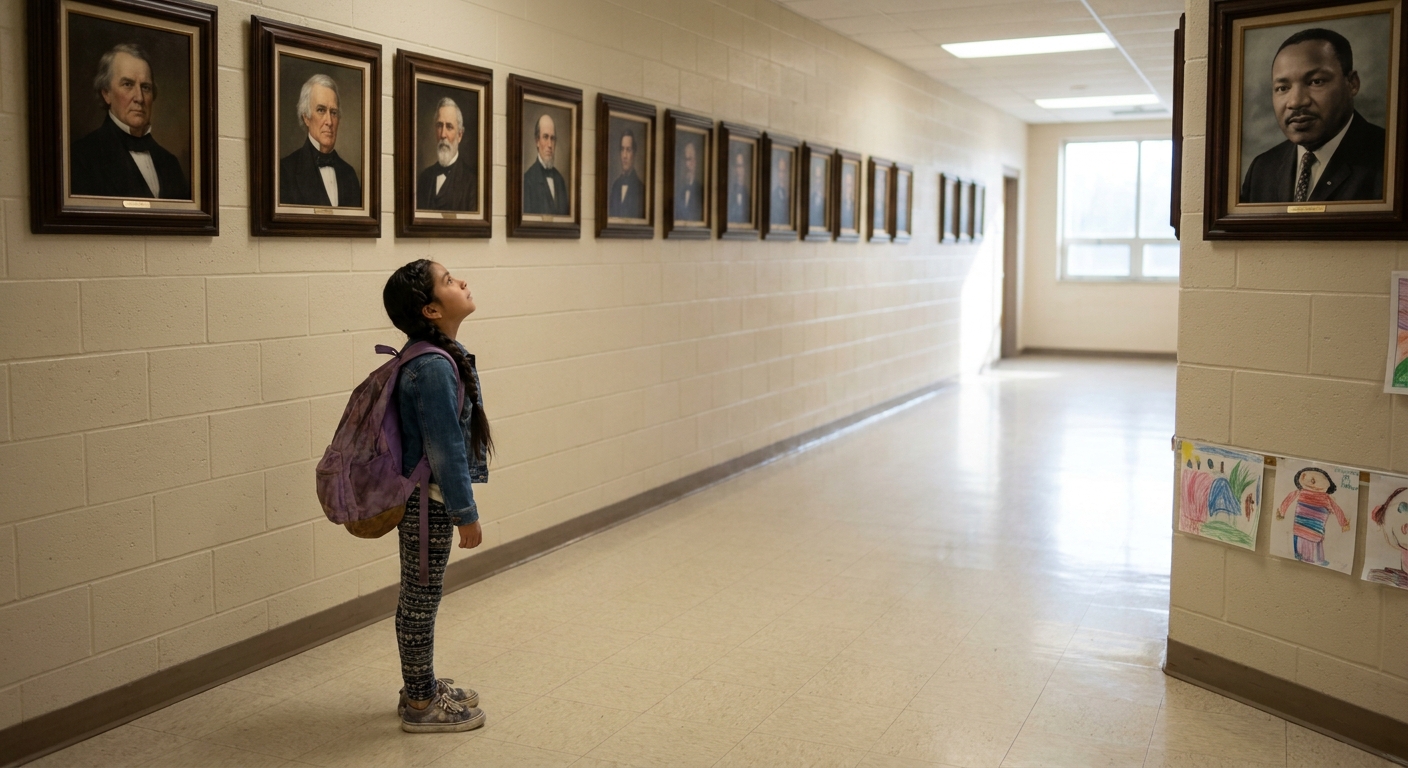
Every day before a teacher opens a textbook, your child's school is already teaching lessons through the portraits on the walls, the names over doorways, and the posters above the water fountain.
When students see their cultural backgrounds, identities, and interests reflected in classroom decor, they perform better, are more engaged in academics, and develop a stronger sense of belonging. Yet 52.8% of K-12 students in Texas are Latinx, while only 5.3% of children's books published in the United States feature Latinx primary characters.
That gap extends to school walls, where a silent curriculum operates—a daily visual message about whose stories matter, whose achievements deserve celebration, and who belongs in positions of leadership and honor.
Texas Education Code §25.081 requires schools to promote a safe and orderly environment that respects diversity, and inclusive decor is considered part of creating an affirming, nondiscriminatory environment. Title VI of the Civil Rights Act and IDEA require schools to avoid discrimination and ensure inclusion for students of all races, cultures, and abilities, meaning displays must reflect diverse races, ethnicities, abilities, and family structures.
If the only scientists on display are white men, if the only Texas heroes are frontiersmen and generals, if every inspirational quote comes from one demographic, children absorb an unspoken lesson about who gets to be brilliant, brave, or worth remembering.
Walk Through With Intention
Conducting a visual audit means walking through your child's school with a notebook, observing whose faces and stories appear in five key zones.
Hallways. Document which historical figures appear on banners and portraits: Do displays include people of various races and ethnicities? Do women appear in leadership or professional roles beyond teachers and nurses? Do the same five or six figures appear repeatedly across grade levels? Many Texas elementary schools use vendor banners featuring Sam Houston, Stephen F. Austin, George Washington, Abraham Lincoln, and Martin Luther King Jr. as standard hallway displays.
Classrooms. Note whether posters feature professionals from diverse fields—scientists, artists, activists, entrepreneurs—and whether cultural celebrations extend beyond a single heritage month. Is student work displayed prominently? Do motivational posters show children who look like the students in the room? Educators are advised to display actual student creations and to let students identify posters that resonate with them, allowing them to curate parts of the wall.
Front office and main entrance. Observe whose portraits hang in positions of honor, whether the school motto reflects values of inclusion and belonging, and whether multilingual signage welcomes families who speak languages other than English.
Library. Check whether bulletin boards highlight authors and characters from diverse backgrounds, whether biography sections feature women and people of color proportionate to their historical contributions, and whether book displays rotate to feature Hispanic Heritage Month, Black History Month, Asian American Pacific Islander Heritage Month, and Indigenous Peoples' Day.
Athletic spaces. Look for whether trophy cases and hall-of-fame displays include girls' teams and individual female athletes, whether motivational posters feature athletes of color and adaptive athletes, and whether team photos reflect the full diversity of student participation.
As you move through each zone, ask three core questions: Who is present—by gender, race, profession, and era? Who is absent—which communities, perspectives, and types of achievement never appear? How are people portrayed—as leaders making decisions or as laborers serving others, as individuals with names and stories or as generic representatives of a group?
Read the Patterns, Not Just the Numbers
Raw tallies tell only part of the story; the patterns in how people are portrayed reveal what the school's visual culture actually teaches about power, achievement, and belonging.
Token inclusion appears when a school adds one scientist of color to a wall of twenty white historical figures, or includes one woman during Women's History Month but returns to all-male displays the rest of the year. Educators are advised to ensure symbols are not token or disingenuous and to include remarkable women, Indigenous people, and people of color authentically.
Watch for whose achievements get honored versus whose labor gets depicted. Do hallway murals show Hispanic Texans only as ranch hands and farmworkers, or also as scientists, business leaders, and elected officials? Are Black Americans represented only through the lens of suffering and struggle, or also through excellence in literature, medicine, technology, and art? Effective representation includes cultural icons like Cesar Chavez, professionals like Mae Jemison, Albert Einstein, and Ruth Bader Ginsburg, and specific identities such as deaf actors like Michael Anthony Spady or Black and Brown women in hijabs for Muslim students.
Watch for essentialism—the reduction of entire communities to a handful of stereotypical images. Are Indigenous peoples shown only in historical dress, never in contemporary contexts? Do posters about Asian American achievement stop at math and science? Does disability representation show only athletes in wheelchairs, never scholars, artists, or leaders?
Notice the difference between celebration and historical documentation. A timeline of Texas history that includes figures like José Antonio Navarro and Santa Anna serves a curricular purpose, but if those are the only times students see Hispanic names, the lesson is that Hispanic contributions belong only to the past.
Schools should also avoid narrowing the decorative focus so exclusively to minority groups that the majority group feels excluded. And pay attention to whose stories are told with complexity: do displays give full names, dates, and accomplishments, or do some figures get reduced to first-name-only treatment or vague labels like "civil rights activist" without specifics?
Texas Schools Making Progress—and Persistent Blind Spots
Across Texas, schools and districts are reimagining their visual culture to better reflect the students they serve.
The 2021 Texas Essential Knowledge and Skills (TEKS) updates mandated the inclusion of more diverse figures like Katherine Johnson, Sally Ride, Mae Jemison, Mario Molina, Ynes Mexia (a Mexican-American botanist), and Marie Daly (a chemist), addressing previous gaps in representation. Classroom and hallway displays in Texas now frequently feature scientists such as Ellen Ochoa (first Latina astronaut and director of the Johnson Space Center in Houston), Mario Molina, and Helen Rodríguez Trías (pediatrician).
Houston ISD and Austin ISD conduct internal equity audits that include reviewing classroom visuals for representation gaps, assessing whether posters include Black, Brown, Indigenous, disabled, LGBTQ+, and multilingual students.
Some districts have confronted naming decisions head-on: Austin ISD delayed a 2018 vote to rename five schools—including Johnston, Lanier, Reagan, and Fulmore—named for Confederate figures, citing a mismatch with district values. At least 24 schools in Texas still bear the names of Confederate leaders, despite 10 having been renamed in Austin, Dallas, and Houston since 2016.
Yet even in schools with updated TEKS-aligned posters, blind spots persist—women may appear as scientists but rarely as military leaders or entrepreneurs; disability representation may stop at physical disabilities and exclude neurodiversity; LGBTQ+ historical figures may be omitted entirely or their identities erased from their biographies.
Recent laws have introduced new tensions: a Texas law requires all public school classrooms to display the Ten Commandments posters if donated, and a separate law (HB 2012) protects teachers' right to display "In God We Trust" posters without school district interference. Sixteen parents sued to stop Senate Bill 10, the Ten Commandments display law, arguing it is unconstitutional and promotes religious intolerance.
In 2018, in Southlake, Texas, parents fought back against a school district's proposed diversity education plan after a video of students chanting a racist slur went viral, illustrating resistance to diversity initiatives in some communities. These tensions underscore why parent advocacy matters: the visual curriculum is contested ground, and schools need support from families who understand that preparing children for a diverse democracy means showing them the full American story.
Approach School Leaders With a Plan
Armed with your visual audit findings, the next step is advocacy—but how you frame your request matters as much as what you're asking for.
Start with shared values. Rather than leading with accusations of bias, frame your request around goals every educator shares—preparing students for college and career success, fostering strong citizenship, and ensuring every child feels they belong. Explicitly link your request to the school's mission, strategic plan, and existing diversity policies, and propose specific, measurable year-one goals to show feasibility.
Lead with a personal story. Board members are influenced by narratives that illustrate how policy gaps affect families; include a concrete example showing the issue's impact on your child while citing data on the district's demographic gaps.
Build coalitions. Bring multiple parents from varied backgrounds to demonstrate diverse community support; coordinating with multiple speakers during public comment periods leverages limited time and demonstrates community strength.
Move from complaint to solution. Instead of just raising concerns, submit draft policy language or request a policy agenda item. Volunteer to research affordable portrait sets, coordinate a parent committee to review options, or organize a teacher wish list for classroom materials that reflect student diversity. Focus advocacy on systems change—curriculum frameworks, staff professional development requirements—rather than individual grievances, which aligns with the board's governance role.
Push for accessible meetings. Advocate for the board to provide simultaneous translation, hold meetings at various times, including evenings and weekends, and offer childcare to accommodate working families.
Anticipate concerns. Some parents and board members may worry that diversifying displays means removing historical figures or imposing political agendas. Clarify that you're asking for addition, not subtraction—that George Washington and Abraham Lincoln can share wall space with Harriet Tubman and Cesar Chavez. Employers value cultural competency, colleges seek students who can navigate difference, and citizenship requires understanding perspectives beyond your own—skills that begin with seeing diverse excellence honored on school walls.
Affordable Resources Ready to Use
When you approach your school, come prepared with specific resources that are affordable, curriculum-aligned, and ready to order.
TeachersPayTeachers offers historical figures posters and Texas history classroom decor, with many affordable and curriculum-aligned sets available.
The Smithsonian Latino Center provides free digital materials highlighting Latina scientists and leaders that schools can print and frame.
IDRA (Intercultural Development Research Association) provides resources on diverse scientists for Texas classrooms, including information about the 2021 TEKS updates.
Edutopia offers research-based best practices for creating inclusive visual environments, including guidance on representation diversity, avoiding essentialism, and incorporating student voice.
Texas-specific figures that align with TEKS standards and deserve hallway space include José Antonio Navarro (Texas revolutionary and only Mexican-American signer of the Texas Declaration of Independence), Barbara Jordan (congresswoman and constitutional scholar from Houston), Bessie Coleman (first African-American woman aviator, born in Texas), Jovita Idar (journalist and civil rights activist from Laredo), and Raul A. Gonzalez Jr. (first Hispanic justice on the Texas Supreme Court).
For STEM representation, highlight figures with Texas connections like Ellen Ochoa, Mario Molina (Nobel Prize-winning chemist), and contemporary scientists from Texas universities and research institutions.
And remind schools that student-created displays offer the most authentic and cost-effective representation: assign biography projects where students research and design posters about figures who inspire them, then rotate those creations through hallway displays.
The goal is not to overwhelm schools with demands but to make inclusive representation easy, affordable, and aligned with what teachers are already teaching—removing barriers so that the portraits on the walls finally reflect the full story of who built Texas, who contributes to America, and who your children can become.